Word entry
Open the word entryMay spoil a puzzle
sheaf meaning
Sheaf is a noun for a number of things gathered or held together as one bundle, especially cut stalks of grain or a set of papers. Many thin pieces kept together as one unit is the core sheaf meaning. You say it "sheef," and the plural is sheaves, said "sheevz." A separate figurative sense means a large number or amount of something.
Sheaf Meaning for Grain and Papers
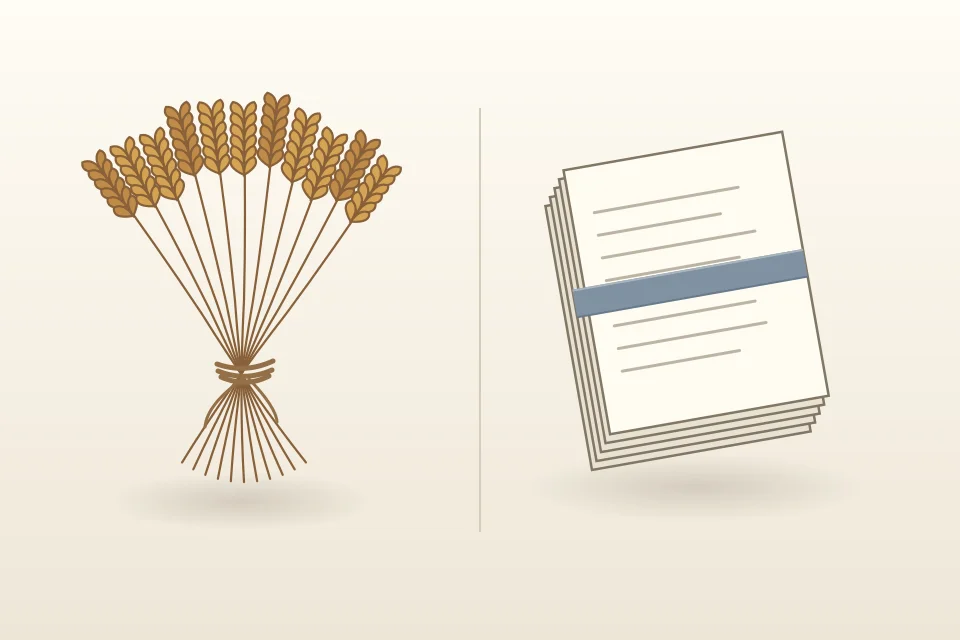
The word fits two objects that look nothing alike at first. They share the same basic shape.
The first is a sheaf of grain. When a crop such as wheat or oats is cut, the stalks can be gathered and bound into one bundle. Each stalk is long and thin. Bound together, they make a single upright bundle you can lift, carry, and set down. Other cut plant stems gathered the same way can also be called a sheaf.
The second is a sheaf of papers. This is a set of sheets someone has gathered into one group, like the pages a person carries into a meeting, hands across a desk, or picks up from a printer. The pages might be clipped, folded, tied, or simply held in one hand. Nothing has to wrap them. What matters is that they stay together and get treated as one batch.
Side by side, the connection is plain. In both cases, many separate pieces become one handful. That's why the same word works for a field at harvest and a desk at work.
How to Say Sheaf and Sheaves
In American English, sheaf has one syllable with a long e sound and a plain f at the end. It rhymes with leaf and beef.
The plural is sheaves. It keeps the same long vowel, but the final f becomes a voiced v, followed by a z sound: "sheevz." You can hear the difference in a phrase such as "two sheaves of wheat."
The f-to-v change belongs to this word. It isn't a pattern you can apply to every English noun that ends in f, so check a dictionary before guessing the plural of another one.
Counting Sheaves
You count a sheaf by the bundle, not by what's inside it. One bound bundle of wheat is one sheaf, whether it holds a few dozen stalks or many more. One set of pages handed to you is one sheaf, whether it has five sheets or fifty.
So "a sheaf of papers" is a single item, and "three sheaves" means three separate bundles. To say how many pages are in one bundle, count the pages directly, as in "a sheaf of about thirty pages." Use the plural sheaves only when there really are several distinct groups.
The Figurative "Large Amount" Sense
Dictionaries also record a figurative reading: a large number or amount of something. Here no physical bundle exists. The word borrows the image of many items gathered in one hand.
For example: "She came back from the workshop with a sheaf of new ideas for the garden." Ideas can't be bound or carried, but the phrase suggests a full handful of them.
This sense sits alongside the concrete ones without replacing them, and context decides which one a reader pictures. With letters, forms, or receipts, a reader may imagine actual paper. With ideas, impressions, or plans, the bundle is only an image. Some sentences could go either way, and that's fine.
Sheaf Meaning in Practice: Folder, Stack or Bundle?
These words overlap, and the best choice depends on what you want the reader to see.
A folder is a container. You put papers into a folder, and the folder isn't the papers. If you hand someone a folder, they open it to find the sheets inside.
A stack describes an arrangement: things laid flat on top of one another. A stack of papers usually rests on a surface, and a stack can hold things a sheaf never would, such as plates or boxes.
A bundle is the broadest word. It covers clothes, sticks, cables, or cash tied together, and it can stand in for sheaf in many sentences. Sheaf is narrower. It points to many thin, similar pieces gathered into one group, and it gives a more specific picture.
Some scenes fit more than one word. A neat packet of printed pages on a desk could be a stack or a sheaf. Stack draws attention to the layered pile. Sheaf presents the pages as a gathered set. When the pages are being picked up, carried, or handed over, sheaf often reads naturally. When they're resting in layers, stack often does. Treat that as a tendency, not a rule.
More entries that explain words this way are collected under Words.
In use
The volunteer tucked a sheaf of sign-up sheets under her arm and walked to the front table.
At the harvest fair, children helped bind sheaves of wheat to decorate the barn door.
He slid a thin sheaf of receipts across the counter and asked for a refund.
Before the hearing, the lawyer pulled a sheaf of notes from her bag and checked the top page.
The first week at the new school left him with a sheaf of impressions he couldn't yet sort out.
Sheaf in Wordle
Sources
- NYT Wordle, November 27, 2026
- Merriam-Webster: sheaf
- Cambridge Dictionary: sheaf