Word entry
Open the word entryMay spoil a puzzle
stent meaning
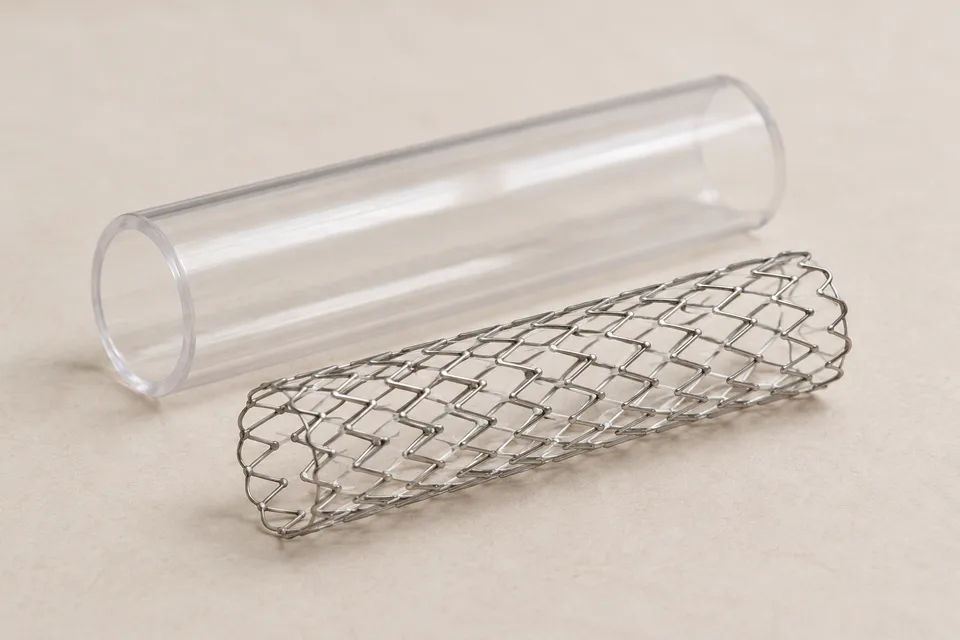
Stent is a noun for a small tube or frame placed inside a passage in the body, such as a narrowed blood vessel or an airway, to help hold it open. The stent definition covers devices made of different materials, including metal mesh and soft silicone.
Stent Pronunciation
Cambridge gives the pronunciation as /stent/ in both UK and US English. The word has one syllable. It starts like "step" and rhymes with "bent." The plural "stents" adds an s sound at the end. The procedure word "stenting" has two syllables, with the stress on the first, STEN-ting.
Stent Meaning in Medical Writing
Stent is a countable noun. You can have a stent, the stent, one stent or two stents, and the plural follows the regular pattern of adding s. A report that mentions "two stents" tells you more than one device is involved, and "the stent" points back to one already mentioned.
Medical writing often pairs stent with the verb place. In "the team placed a stent in the artery," place means to put something into position. The same idea becomes a noun phrase in "stent placement," which names the event of putting the stent where it belongs. You will see it in headings and summaries such as "date of stent placement." Reports also use the passive "a stent was placed," which keeps the focus on the device rather than on the person doing the work.
Stenting is the -ing noun for the procedure itself. It names the whole process, so writers can say "stenting of the artery" or compare stenting with other approaches. You may also meet stented as an adjective, as in "the stented section of the vessel," meaning the part that now has a stent inside it.
Coronary Stent, Airway Stent and Other Descriptive Words
The word before stent often tells you where the stent sits. A coronary stent is placed in a coronary artery, one of the blood vessels that supply the heart muscle itself with blood, so "coronary" names a location. An airway stent is placed in an airway, such as the windpipe or one of the large breathing tubes that branch into the lungs.
The modifier can also tell you what kind of device the writer means. Silicone names a material, and drug-eluting describes a coating that releases medicine over time. That first word adds a detail to the basic stent meaning.
Stent vs Catheter
A catheter is a tube, often thin and flexible, with a wide range of uses. Depending on the type, a catheter might drain fluid, deliver fluids or medicine, measure pressure, or guide other tools to a spot inside the body.
The two words often appear together because one can help deliver the other. In one example from the National Heart, Lung, and Blood Institute, a thin catheter carries a stent through a blood vessel to the narrowed area and is withdrawn once the stent is in place. In that example, the catheter serves as the delivery tool. The stent remains in the passage to help keep it open.
Stent in a Sentence
- "The science museum used a clear plastic tube and a small wire frame to explain stenting to visitors." Here stenting names the procedure, and the model shows a frame holding a tube open.
- "The summary recorded the date of coronary stent placement." Coronary stent placement works as one noun phrase. Coronary gives the location, and placement names the event.
- "Her grandfather's hospital letter mentioned two stents in different arteries." The plural stents signals more than one device, and the phrase after it gives the locations.
- "The article described an airway stent made of silicone." Airway tells you where it sits, and silicone tells you what it is made of.
In use
The textbook drawing labeled the airway stent in blue.
A short video explained the difference between a stent and a catheter.
The radiology report listed stent placement among the day's procedures.
Two stents of different lengths sat side by side in the display case.